Nut Ink. Mini reviews of texts old and new. No fuss. No plot spoilers. No adverts. Occasional competency.

Monday, August 19, 2013

Lone Wolf and Cub: Omnibus: Volume One (2013)

Author: Kazuo Koike | Illustrator: Goseki Kojima | Page Count: 712

"I beg of you. Use your sword to rid our lord of these jackals at his side."

Lone Wolf and Cub is the story of the swordsman Ogami Ittō and his young son Daigoro. Ogami was once the Shogun's loyal executioner, but now he's a hunted rōnin (a sword for hire). Together, man and child travel a path beset on all sides by enemies; it's a path of vengeance that'll take them directly into Hell.

Structurally it's episodic. Ogami roams from village to village, contract killing for money to buy food and shelter, but the bigger picture is never forgotten: the hunt for revenge is the reason he moves that way and he won't stop until it's achieved.

He's a superb tactician and a lateral thinker as quick with his wits as he is with his sword. Even when all around is death and fury, his concern for Daigoro remains paramount. The bond between them is unshakeable.

Creator Kazuo Koike's storytelling is masterful. Every word has purpose. Ogami says very little, so when he does speak we know to sit up and pay attention.

Much of the time Kazuo lets Goseki Kojima's amazingly kinetic black and white visuals carry the story along. It's not the typical, clean-lined, big-eyed style you may picture when you hear the word 'manga'. It’s grittier with deft strokes of the pen. When the blood starts to fly, Goseki captures the intensity better than any other manga artist I've ever encountered.

I'm happy to report that Dark Horse chose not to attempt to translate words with no direct English equivalent. Instead, they included a short but informative glossary of terms at the back of the book to explain the meanings.

The book collects together chapters 01 - 16 of the original Lone Wolf and Cub manga (all of Vol 1: The Assassin's Road; all of Vol 2: The Gateless Barrier; and the first part of the stories from Vol 3: The Flute of the Fallen Tiger).

4½ twisted ropes out of 5

Thursday, August 1, 2013

Judge Anderson: PSI Files Volume 3 (2013)

Authors: Alan Grant / Peter Milligan / Dan Abnett / Andy Lanning |  Illustrators: Arthur Ranson / Steve Sampson / Charles Gillespie / Angel Unzueta / Ian Gibson / Trevor Hairsine / Eddy Cant / Mick Austin / Anthony Williams | Page Count: 304

"...My blood's so red, and the ground is so far, far away..."

Alan Grant drags Anderson even deeper into the realms of philosophy and religion in this volume.  Her hitherto discoveries about her past, coupled with a recent changed perception of what ‘Justice’ is, have opened her consciousness to previously unexplored concerns affecting Mega City One.  She begins to experience visions that lead her into the unknown.  The iconography used will be familiar to everyone but the associations are Anderson specific.

There’s quite a lot of Dredd in this one.  It’s interesting to see Old Stony in Anderson’s world.  It distances him a little from the typically masculine arena he usually embodies.  Grant knows that Joe needs to present the appearance of a non-conformist with a controlling influence but there’s also an almost parental guiding attitude present.  He won’t accept failure from Anderson but he’s more than happy to step aside to let her prove herself, or team-up if the Law permits.

The two main artists are Arthur Ranson and Steve Sampson.  I've mentioned my love for Ranson in previous reviews so I’ll skip over that this time.  Steve Sampson has a radically different style.  His use of thick, bright colours contrasts with Ranson’s more subdued, realistic palette but it works beautifully.  Sampson’s portrayal highlights a different side of Cassandra.  She has a glow about her, as if her emotions are shining out from within like a beacon or a redeeming light.  His panelling is equally vibrant when necessary; the more space he allows himself the more impressive his final product.  He's my 2nd favourite Anderson artist.

As usual there's some random one-shots from annuals and yearbooks to close the book that neither match up to the main stories in terms of quality or continuity.

I’d encountered most of this volume before on first printing but it was shortly after the last multi-part work that Grant put Anderson on hiatus, and (for unrelated reasons) I stopped buying the magazines, so Vol 4 will be mostly new to me.  I can’t wait for it to appear.

4 Books of Man out of 5

Sunday, July 21, 2013

Reflex (2004)

Author: Steven Gould | Page Count: 380

The sequel novel to Jumper takes place about 10 years later from the first book. Davy and Millie are married and she earns a living as a therapist while Davy takes infrequent assignments from the NSA only if they are nonviolent or otherwise morally straight. Davy goes to a typical meeting with his handler when he is unexpectedly drugged and kidnapped. This sets Millie off on a search for him assisted by agents from both the NSA and FBI. The perspective alternates between chapters from Millie to Davy as she searches for him and Davy tries to learn more about his mysterious captors who have somehow found out enough about him to be able to restrain his teleportation abilities.

The sequel has moved past the character building of the first novel and is mostly now a straight up thriller. The characters are still as readers know them just in a larger story that the author manages to make feel authentic with some interesting stretches of science fiction. Most notably the question of restraining a teleport and some other technicalities of physics show Gould has an understanding of science that helps ground the story in a sort of reality. Albeit one where teleportation is possible. Mixed with the the mystery and intrigue of spies and conspiracies makes for an entertaining read.

"In the box" reflexes out of 5

Thursday, July 11, 2013

The Dark Tower: Book I: The Gunslinger (1982)

Author: Stephen King | Page Count: 212

'No one ever really pays for it in silver, he thought. The price of any evil – necessary or otherwise – comes due in flesh.'

Book One is your introduction to Roland Deschain, also known as Roland of Gilead, the titular gunslinger. Roland is a man obsessed. His obsession carries him across Mid-World, the land of his birth. Mid-World is a familiar amalgamation of our own recorded history and a romanticised version of the same. It's the type of fictional reality that fans of King's other works will feel right at home in.

Now would be a good time to say that this isn't a Horror novel. It's Fantasy merged with the old-fashioned Western, but it's still populated with the kind of well-defined characters that the author is so very good at. Love him or loathe him, you can't deny his strengths.

Later books in the series take too damn long to get to where they're going (some could do with at least 100 pages trimmed off the beginning), but this one is more focused. There's no unnecessary waffle. There are flashbacks to earlier times at opportune moments but they aren't whimsical, they offer a deeper insight into the present situation and help explain why Roland acts like he does. You may find him hard to connect with initially, but as his story deepens so too does his depth of character and his principles become less obtuse.

The book was written over a period of twelve years (when time allowed between other projects) and originally published as five short stories before being collected together. The progression in the writing is clear to see. If you compare the earliest part with the later parts, you'll see a huge difference in quality.

You should know before you even begin that the series, originally planned to reach approx 3000 pages in length, swelled to eight books that if collected together would be a whopping 4250 pages long.* Also, that's assuming King has finished with the series. I suspect he's got some more Dark Tower in him, so that figure could increase in the future. That's not to say it's unfinished. It did get an ending, but there are stories that could be told within the existing framework, as evidenced by the interquel, The Wind Through the Keyhole (2012).

3½ gateways out of 5

*That figure is obtained from my own copies, which are a mix of paperback and hardback. King revised the first book in 2003. The listing on amazon gives a 304 page count for it. That would add another 92 pages to the tally.

Wednesday, July 10, 2013

Sláine: The Lord of Misrule (2011)

Author: Pat Mills | Illustrators: Clint Langley / Greg Staples / Jim Murray
Page Count: 128

'He wasn't wearing the horns... the horns were wearing him...'

Sláine, now a time-travelling instrument of the Earth Goddess, gets dropped into historical events circa 1140 AD.  It’s more akin to a death / rebirth cycle than time travel but that’s semantics, the important thing is he’s tasked with destroying the Blood God so that the false religion he preaches can be torn down and the old religion put back where it belongs.  Christians will be upset.

You’re going to have to accept the time travel aspect if you’re to get any enjoyment out of it.  Why can’t one person be born again and again to better represent the many aspects of the Horned God?   I don’t think it’s as anachronistic as some folks accused it of at the time.  In fact, I think it’s aged better than some of the other Sláine stories.

Along the way our anti-hero gets to bury his axe in some Norman head, because it wouldn't do to go some place new and not slaughter a few dozen zealots.

A lengthy prelude (The Name of the Sword) begins the work.  It chronicles Sláine’s slipping into the boots of the Goddess’ champion of the time, with painted art by Greg Staples.  It’s a necessary set-up to get to the good stuff - the good stuff being the titular Lord of Misrule story.

Clint Langley takes over for the main feature.  He lets his brush go wild inside and outside panels with some two-page spreads that show how dynamic Sláine can be when he’s given room to really spasm out.  Langley hadn't started dabbling in his photography / digital art in '95 so it was regular pen and inks.  However, the 2011 collected edition was recoloured.  Please stop recolouring stuff!

The story ends abruptly, which is something that happened a lot in 2000AD because the anthology format usually meant a conclusion had to be given in the limited page count of one issue.  There’s an epilogue to try and make up for it.  It feels like a bonus rather than an unnecessary stretching out.

The book collects together The Name of the Sword (Progs 950 - 956), Lord of Misrule (Progs 958 - 963 + 995 - 998), and The Bowels of Hell (Prog 1000).

3½ two finger salutes out of 5

Saturday, July 6, 2013

Death in Five Boxes (1938)

Author: John Dickson Carr | Page Count: 310

"After inspecting the wreckage, he sat down on the running-board of the car, picked up a banana, peeled it, and malevolently began to eat it."

Death in Five Boxes is the seventh of Carr's Sir Henry Merrivale stories, and although it's one of the weakest, it still has some lovely riddles. It's an entertaining, borderline comical murder mystery with a cast of characters who almost feel like they've come out of a board game. In fact, there's much that feels game like about this tale. Characters bounce theories off each other like players trying their hardest to put together a solution to a complicated brainteaser.

The appeal of Carr's mysteries lies largely in his impossible crimes and intricate puzzles, and unfortunately, this might be this tale's biggest flaw. The main trick is a great one, but it's so good that it's been lifted and reused time and time again. The minor mysteries aren't as satisfying to solve, and one solution in particular feels rather cheap. Still, the mystery itself is fairly solid, and an intrepid detective should be able to solve it before Merrivale makes his grand reveal.

This is a story only for mystery die hards. The writing and characters are nothing special, and there's not much to recommend aside from the thrill of puzzle solving. Still, it's a quick read, and if you'd like to work your way up to the best Carr has to offer, it's not a bad read.

 2 suspicious uncles chucking flowerpots at constables out of 5.

Friday, July 5, 2013

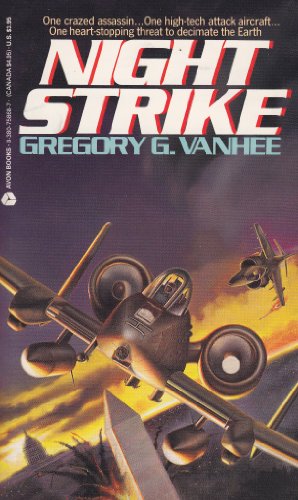
Night Strike (1990)

Author: Gregory G. Vanhee | Page Count: 375
"Oh, c'mon, Kelly. This is all just a bit maudlin, isn't it?"
Not actually maudlin. Somewhat entertaining, kind of cheesy and a little dated now, but the latter can't be helped. The story follows protagonists J.R. Kelly, a gruff, balding cop turned CIA agent, and Rosemary Hawkins, a national security advisor known for using her feminine wiles and her political savvy to get ahead, while a domestic terror plot is brewing against the president.

That was a very non-spoilerish description despite how much is given away on the damn cover just above and on the back of the book and through very blunt foreshadowing that ends many chapters. The book is a halfway decent thriller that is a conservative wet dream about sexy women, spies, booze and destroying commies with high tech toys in the height of Cold War tensions. Or rather what a liberal thinks is a wet dream of conservatives. It comes off almost as a parody of the spy thriller genre, but seems to be totally serious. It at least doesn't diminish the entertainment value and is the literary equivalent of a summer blockbuster filled with explosions. Partly engaging and then mostly forgotten once it's done, but not necessarily bad.

Old white Blue-Bloods are evil incarnate out of 5