Nut Ink. Mini reviews of texts old and new. No fuss. No plot spoilers. No adverts. Occasional competency.
Showing posts with label N. Show all posts

Friday, August 14, 2015

The League of Extraordinary Gentlemen: Nemo: River Of Ghosts (2015)

Author: Alan Moore | Illustrator: Kevin O'Neill | Page Count: 56

"It was the piranhas mostly. They can be spiteful if they're in yer trousers..."

Eighty-year-old Janni gathers together a crew (one of whom would've certainly been worthy of League membership in an earlier time) for one last sailing of the Nautilus into the heart of darkness; i.e. up the Amazon. Her ultimate goal is to put to rest someone who ought to have been dead years before, someone we've met before and for whom death was initially a long time coming.

She’s wizened and determined, with a face that looks like it’s been carved out of wood. Many of the crew think her mad, but she’s knows the truth.

It’s not usually until my second read-through that I'm able to appreciate the intricacies of the League books. I'm too busy trying to spot extraneous references and getting lost in the backgrounds during the first read. But I enjoyed River of Ghosts on the first pass. Either Moore has finally found a suitable level of outside influences being pitched inside, or I simply overlooked a ton of them. Either way, it was a more fluid experience, enabling me to get caught up in the yarn easily.

The aforementioned crew member is Janni’s bodyguard. He's an amalgamation of more than one fictional/legendary character, and more than once he steals the show with his actions; at one point he even does it while having lunch.

The ending is abrupt, but the entire thing had been leading organically up to it, so in the overall scheme it’s simply punctuation that serves a dual purpose. If you've followed the journey up until now then there’s no reason not to step aboard for the conclusion to the trilogy. If you've been hesitant because of how it was split over time, as was the case with Century it'll likely get a collected edition sometime in the future with new O'Neill cover art; an option is to wait for that.

3 broken lady parts out of 5

Wednesday, June 3, 2015

Clive Barker's Nightbreed: Volume 1 (2015)

Authors: Clive Barker / Marc Andreyko  |  Illustrator: Piotr Kowalski  |  Page Count: 112

"Midian calls to all of her children. No matter where we are..."

Given the choice, I’d rather have had a sequel novel than a prequel comic book, but a comic version of Nightbreed that's canon is better than nothing at all, I guess.

It’s a story set in the present, broken periodically with flashbacks to years before. To confuse matters, the 'present' is the year the film is set, so, yes, you'll need to have viewed the film prior to reading, and the flashbacks are from a number of different perspectives, each one telling the story of how a particular member of the collective lived prior to finding the safety of Midian.

I had a secret hope that the series would do what the film failed to do: flesh out the inner-workings of Midian and deepen the concerns of the creatures, warts and all beyond just: we may be ugly on the outside but humans are morally uglier on the inside. With that in mind, it begins badly. Presenting Peloquin as a kind of monstrous version of Wolverine was worrying. Thankfully, his story is just one of many spread out over the years with each era given its own visual look.

The histories continue in a similarly bland fashion until the end of issue three. Without going into detail, an unexpected element is introduced that may (fingers firmly crossed) turn out to be a pivotal happening further down the line. There are a number of different routes it could take and I'm guessing that most—if not all—of them end in bloodshed. The only question is whose blood; Natural or Nightbreed?

The cover art by Riley Rossmo is excellent but misleading. Only about half of those shown actually feature in the first volume. I didn't feel cheated because squeezing any more in would've made the story seem even more piecemeal than it already is, but it's worth mentioning, nonetheless, in case one of those pictured is your favourite and you were really hoping to find them inside.

The book collects together Clive Barker's Nightbreed issues 1-4 (of 12).

2½ learned behaviours out of 5

Monday, October 6, 2014

The Night Watch (1998)

Author: Sergei Lukyanenko  |  Translator: Andrew Bromfield  |  Page Count: 489

'Many years ago someone told me something that I flatly refused to accept.  And I still don't accept it now, despite all the times I've seen it proved right.'

Night Watch are the good guys; up to a point.  They have their own agenda, like any organisation, but on a day-to-day basis they’re responsible for policing the actions of their opposites, the Dark Others.  The Dark ones draw their power from the negative feelings of mankind; some even feed on mankind itself, but that requires special dispensation.  Balance is all important.  If the evil should outweigh the good, the world is screwed.  If the good should outweigh the evil, the world is screwed from the other side.  But knowing that doesn't stop either side from trying to achieve dominance.  Among the casualties will be us, the humans.

Both the Light and Dark Others, irrespective of rank, have access to a deeper level of reality known as the Twilight, a place that exists beneath the fragile top skin of our own world.  The Twilight has many uses but equally as many dangers.  It's not a place for sparkly vampires who like to sniff girls.

Much like the Twilight, the events in the novel take place on a number of layers: there’s the familiar world we know; the unfamiliar world of the Watches; and the fantastical world that we can imagine exists all around us, separate from but wholly dependent on the other two for its contrasts and sense of magical realism.

Anton Gorodetsky exists in all three of those worlds; he's our guide.  Anton is a Light Other, relatively new to field work.  He patrols the night, hoping to catch the Dark ones doing something they ought not be doing so that he, and his organisation by extension, can gain an advantage in the inevitable war.  He knows that even little things, if left unchecked, can develop into catastrophic things.

The urge to read faster almost overwhelmed me as I neared the end of the novel, as the layering increased even more, but I knew I had to keep pace or risk overlooking something crucial.  Only the best stories have that quality.

4½ divergences in the probability field out of 5

Wednesday, April 2, 2014

The League of Extraordinary Gentlemen: Nemo: Roses of Berlin (2014)

Author: Alan Moore | Illustrator: Kevin O'Neill | Page Count: 56

I think I recognise my conscience on those rare occasions when I meet it.”

Roses of Berlin is set in 1941.  An adversary from Janni‘s past, typically unnamed but recognisable, returns to make life difficult for her and her family.

Moore brings a few things back from past adventures to keep the continuity going, and heaps some new content on top to keep things fresh.  As usual, he fills his narrative with obscure references to people and places that will alienate a great many readers.  To get the most from the story you’ll need some knowledge of WWII politics and silent era cinema, particularly the German Expressionist movement.  I have some of the latter, but not so much of the former.  Realistically, though, I suspect that percentage will be reversed in the majority of cases.

He further alienates readers by having some of the text in German without a footnote translation.  I only know about ten words in German, so I was unable to understand what was going on in those scenes.  There’s also some minor French dialogue.  I could read it but it wasn't at all necessary to understanding the plot.  It merely reinforces what we've already been told, which begs the question of why it was included at all.  I can’t say the same for the German pages, though.  They could be similarly unnecessary, or they could be crucial.  Fuctifino.

Overall, perhaps partly because of what’s mentioned above but not completely, I found this volume lacking.  The cinematic elements were fun and action packed, but the story didn't feel like it warranted its own separate edition.

Nothing to do with the plot but notable nonetheless is the return of the League title on the cover after being absent on Heart of Ice (2013).

2½ propaganda broadcasts out of 5

Monday, December 2, 2013

The Naked Sun (1957)

Author: Isaac Asimov | Page Count: 208

'Perhaps it was annoyance that caused him to forget.  It was Daneel who annoyed him, he thought, with his unemotional approach to problems.  Or perhaps it was himself, with his emotional approach.'

The sequel to Asimov's The Caves of Steel (1954) is the second full length novel in his Robot Series. It once again pairs up the Earth-born Detective Elijah Baley (now a C- 6) with the Spacer Robot Danell Olivaw.

It begins with a brief journey to help the reader recall what happened one year before. It doesn't recount all the events of the previous novel, it just helps set the scene and reminds us of the working relationship between the two men.

Elijah, who's spent his entire life in the vast underground cities of Earth, has to venture to one of the Outer Worlds, Solaria, to investigate a murder. Why do the usually self-sufficient and technologically superior Spacers need terrestrial assistance to investigate a murder on their private soil? No human has set foot on Solaria in over a thousand years. And why did they choose him, speicifically?

In the previous novel it was Danell who was the outsider; now it's Elijah, and he's way out of his comfort zone. He's forced to use his talents to uncover the murderer, while simultaneously struggling with fears about the environment.

The difference between the two cultures seems staggering at first, and any hope of finding the killer impossible, but Lije knows there's more at stake than just his own reputation: he's a representative of Earth, and he's determined to show the arrogant Spacers that Earthmen aren't as stunted as they seem to think, even if that means pushing a few angry buttons.

The story moves along at a steady pace, in a typical mystery novel way. The ending makes it clear that everything up to that point was merely to facilitate what Asimov wanted to say from the beginning, but by using the unique characteristics of Bailey and R. Daneel he was able to better achieve that goal, and in true sci-fi style he manages to both look to the future while referencing the present and the past.

3½ long-distance relationships out of 5

Friday, July 5, 2013

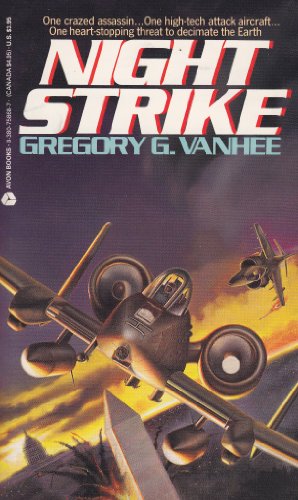
Night Strike (1990)

Author: Gregory G. Vanhee | Page Count: 375
"Oh, c'mon, Kelly. This is all just a bit maudlin, isn't it?"
Not actually maudlin. Somewhat entertaining, kind of cheesy and a little dated now, but the latter can't be helped. The story follows protagonists J.R. Kelly, a gruff, balding cop turned CIA agent, and Rosemary Hawkins, a national security advisor known for using her feminine wiles and her political savvy to get ahead, while a domestic terror plot is brewing against the president.

That was a very non-spoilerish description despite how much is given away on the damn cover just above and on the back of the book and through very blunt foreshadowing that ends many chapters. The book is a halfway decent thriller that is a conservative wet dream about sexy women, spies, booze and destroying commies with high tech toys in the height of Cold War tensions. Or rather what a liberal thinks is a wet dream of conservatives. It comes off almost as a parody of the spy thriller genre, but seems to be totally serious. It at least doesn't diminish the entertainment value and is the literary equivalent of a summer blockbuster filled with explosions. Partly engaging and then mostly forgotten once it's done, but not necessarily bad.

Old white Blue-Bloods are evil incarnate out of 5

Thursday, March 21, 2013

Nemo: Heart of Ice (2013)

Author: Alan Moore | Illustrator: Kevin O'Neill | Page Count: 56

Frankly, I like the odds better if I'm in a tank.

Heart of Ice is a standalone work that’s nevertheless a part of Moore and O’Neill’s League of Extraordinary Gentlemen series.  You’ll need to have knowledge of the previous books, particularly the Century trilogy, if you want to know how the main protagonist got to be how she is.

It merges the traditional pirate adventure story with the world of one of America’s most celebrated horror writers (circa 1930).

Like before, some character names are changed or purposefully omitted to avoid legal action.  My knowledge of penny dreadfuls is almost zero, so I wasn't familiar with over half of them.  I'd to go to Wikipedia just to find out who the hell the main antagonists were.  The ones I did recognise (an African queen and a notorious 1920’s publishing tycoon) had very little to do with anything once the story got under way.  The fast pace leaves little time for any of the secondary characters to make an impact.

For me, Moore’s repeated use of violence in his portrayal of women isn't a negative thing.  I think the opposite is true: the women hold their own in a world of vile masculinity.  That strength and power of the female is again to the fore.
Janni (Nemo) is a worthy substitute for Mina.  She’s equally as driven and equally as determined to shake off the shackles of her male forbearers.  If the story had the same depth as her then it’d have been much more entertaining.

The swift move from place to place required artist O’Neill to jump from a world of steampunk contraptions to a world of tentacled horror.  Somehow he made it work like he always does.  The League world is as much his as Moore's.

3 giant penguins out of 5

Sunday, August 19, 2012

Neil Gaiman's Midnight Days (1999)

Author: Neil Gaiman | Illustrators: Stephen R. Bissette / John Totleben / Dave McKean / Teddy Kristiansen / Sergio Aragones / Mike Mignola / Richard Piers Rayner / Mike Hoffman / Kim DeMulder | Page Count: 176

'In her dreams her fingers had become tiny snakes.
When she awoke she could not feel her hands; but she could hear her fingers, slithering over the sheets and away from her in the darkness.'

Midnight Days collects together some of Gaiman’s earliest works for DC.  It’s not of his usual high standard, and it’s certainly not the place to start if you’ve not read any of his works before.
He admits in the introduction that he was still finding his feet.
It’s not all bad news.  There are parts of it worthy of praise.  A short piece featuring the wonderful John Constantine is creepy and unnerving, and without a doubt the highlight of the whole endeavour.  Plus, it has art by Dave McKean.

The collection contains six stories in all, one of which came from an unused Swamp Thing script; it was illustrated specifically for the book.  It’s interesting.
Each story has its own full page introduction detailing the creation, or the inspiration behind it.  I enjoyed those, sometimes more than the story itself.

Perhaps the biggest draw, from a completist point of view, is the lengthy noirish Sandman Midnight Theatre, which has the first and only meeting between The Golden Age Sandman (Wesley Dodds) and Gaiman’s Sandman of the Endless.

After being hard to find for many years, it has recently been reprinted as a ‘Deluxe Edition’ (August 2012) with an embossed hardcover, which means they can charge more for the same product.  It’s much too expensive for the small amount of content given; even the most ardent fan will feel a little empty in the pocket.
If it gets a softcover edition, or if you see it on sale, it could be worth picking up.

The book collects together Swamp Thing Annual 5, Sandman Midnight Theatre, Hellblazer issue 27, and Welcome Back to the House of Mystery issue 1.

3 leaves on the hotel carpet out of 5

Monday, July 23, 2012

Naked Heat (2010)

Author: Richard Castle | Page Count: 290
It was to be the last night of her anonymity. She had hoped that, as Mr. Warhol predicted, her fame would only last fifteen minutes and be done, but for the last two weeks, everywhere she went, it was the same. Sometimes stares, sometimes comments, always a pain.

Detective Nikki Heat returns to solve the high profile murder of a gossip writer during a city-wide garbage strike. Compounding the difficulty is the high number of suspects as the tabloid writer had no shortage of prominent enemies and Heat's own high profile which is still flying high in the wake of former ride-along journalist Jameson Rook's cover article detailing her crimefighting. It has caused a rift between the two, but they are forced back together as Rook was profiling the victim at the time of the murder.

The story is more or less the same as before as it reads like a script of its tie-in show which is even pointed out at one point with a joke about commercial breaks and the dialogue is still as snappy as ever though it does focus more on characters than mystery. The mystery is still intriguing though you may find better ones elsewhere. Still perfectly serviceable and like the first book is better when used as intended as a tie-in for the show.

3 Snitches get stitches out of 5

Tuesday, May 22, 2012

Notes from Underground (1864)

Author: Fyodor Dostoyevsky | Page Count: 136

"The best definition of man is: a being that goes on two legs and is ungrateful."

Notes is split into two distinct parts. The first is primarily concerned with human suffering and the complex enjoyment that can be attained from it. The text is presented as an excerpt from the diary of a retired civil servant. He's an embittered soul ranting about how the world is peopled by selfish bastards whom he despises, yet he too is selfish in his emotions and misgivings, so he's a part of the social group that he hates. He's aware of this fact and tries desperately to escape but is unable, which further feeds his misery, and the spiral takes shape.

The second part has the unnamed author relating tales of his awkward interactions with the kinds of contemptible people he was critical of in the first part. If he was to fit into their world, would it enable him to escape the futility and crippling nature of his own? Read the text and you'll find out. It explores human relationships from an 'outsider' point of view, and how reason and logic play a vital role in one's own personal standing with other people.

The second part was, for me, the least interesting of the two, while conversely being the most overtly vicious insight into the narrator's psyche.

If you hadn't guessed already, it's an existentialist text, perhaps even the first of its kind. It's equal parts enlightening philosophy and outright miserable psychology and, in that respect, translates perfectly what the narrator feels.

4 assholes and a prostitute out of 5

Friday, November 18, 2011

The Name of the Wind (2007)

Author: Patrick Rothfuss | Page Count: 722
“Congratulations. That was the stupidest thing I've ever seen. Ever.” - Elodin

The first book in the larger trilogy The Kingkiller Chronicle, The Name of the Wind tells the story of Kvothe; a mysterious innkeeper as he recounts his story to the king’s historian. The story takes him from his childhood in a traveling performers troupe to the hard streets of the city to the grounds of the University (there is only one) in his pursuit of the titular name of the wind. All this while strange events unfold in the present. Are they related to his past?

Comparisons to Harry Potter abound, the similarities are superficial and Name of the Wind has the advantage of not being aimed at a younger audience which author Patrick Rothfuss makes full use of. The characters are well-developed and the story is engaging with adventure, mystery, excitement and Sympathy i.e. magic as Kvothe overcomes trials and tribulations and a prick called Ambrose.

5 sympathetic links out of 5

Short enough yet Doc?